
Electrochemical Energy Storage
NLR is researching advanced electrochemical energy storage systems, including redox flow batteries and solid-state batteries.
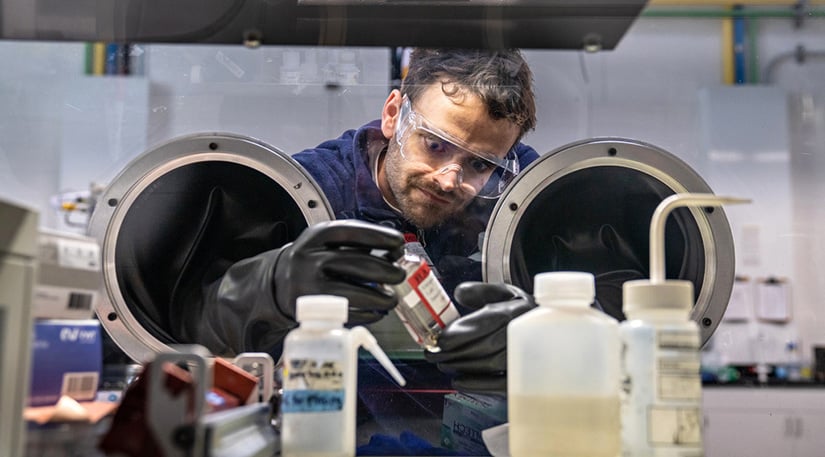
Electrochemical energy storage systems face evolving requirements. Electric vehicle applications require batteries with high energy density and fast-charging capabilities. Grid-scale battery energy storage systems provide services including energy time-shifting and capacity support for power systems with variable generation resources.
Although lithium-ion batteries are already widely used in transportation energy storage, consumer electronics, and stationary storage, NLR researchers continue to evaluate and synthesize novel battery materials and next-generation battery technologies
Learn more about the energy storage facilities at NLR.
Redox Flow Batteries
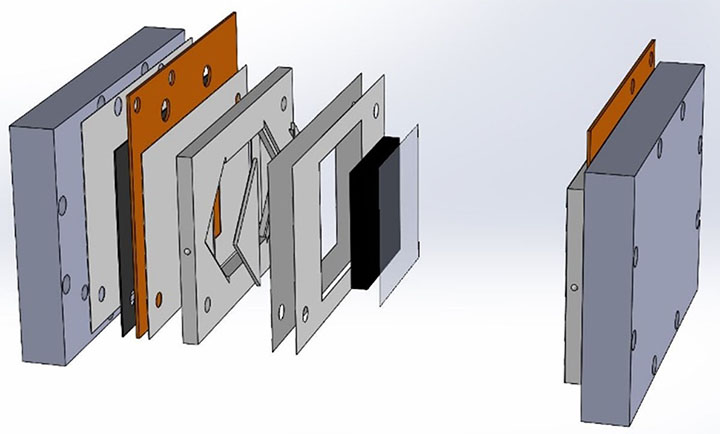
NLR's custom designed open field flow redox flow battery offers optimized electrolyte dispersion and all-inert construction.
New developments in redox flow batteries may offer long-duration, long lifetime stationary energy storage needed to maximize grid resiliency.
NLR researchers are engineering new redox flow battery designs that may enable market deployment of this emerging technology. One design, a scalable flow loop system, is compatible with both aqueous and organic chemistries, which allows researchers to explore compatibility with novel materials to maximize high-power performance.
NLR's rapid prototyping of battery cells and stacks for different chemistries, including a novel organic redox electrolyte developed by our industry partner, to optimize the system and drive down research costs. Additional research seeks to identify low-cost and earth-abundant metal alternatives to the vanadium typically found thin redox flow batteries.
Solid-State Batteries
Solid-electrolyte batteries have the potential to significantly improve the energy density/range of electric vehicle batteries. To support this next-generation technology area, NLR researchers are leading materials discovery and characterization efforts to evaluate the impacts of interface, chemical, electrochemical, and mechanical factors on solid-state battery systems. The interface stability of solid-state battery cells is critical to enable low-cost deployment in electric vehicles and grid applications.
To streamline the future deployment of solid-state batteries, NLR researchers are evaluating high-throughput techniques to optimize cell fabrication, such as roll-to-roll manufacturing. The current high-pressure, high-temperature batch processing used to create solid-state batteries is not suitable for large-scale manufacturing. As part of this research, NLR demonstrated the ability to fabricate functioning pouch and coin cells with thin separator layers and composite solid-state battery cathodes and anodes.
Contact
Share

Last Updated Dec. 7, 2025